
Blogs
First-Party Data SEO: The Ultimate Backlink Guide
Content Editor · November 12, 2026 · 12 min read

First-Party Data SEO: The Ultimate Backlink Guide Businesses collect valuable information every day. Customer feedback, CRM records, product analytics, and support requests can reveal patterns that competitors and industry publishers would find useful. Yet most of this informatio...
First-Party Data SEO: The Ultimate Backlink Guide
Businesses collect valuable information every day. Customer feedback, CRM records, product analytics, and support requests can reveal patterns that competitors and industry publishers would find useful. Yet most of this information never makes it beyond internal dashboards.
First-party data SEO turns those insights into original research that journalists, industry websites, and search engines can reference.
The approach involves analyzing data collected directly by your business, identifying meaningful findings, and publishing them as credible, link-worthy content. Done well, it can attract editorial backlinks, improve organic search visibility, and create opportunities for citations in AI-generated answers.
For B2B SaaS companies and marketing teams, the real advantage is straightforward: instead of repeating information available everywhere, you can publish evidence that only your business can provide.
What Is First-Party Data SEO and Why Does It Matter?
First-party data SEO is the practice of using information collected directly from customers, users, or business operations to create original, search-focused content.
Unlike generic industry articles, proprietary research can provide findings that other publishers cannot easily reproduce.
First-Party vs. Third-Party Data
Understanding the distinction helps businesses identify useful research opportunities.
| Data type | Definition | Example |
|---|---|---|
| First-party data | Information collected directly by your business | CRM records, website analytics, product usage |
| Second-party data | Another organization’s first-party data shared directly with you | Research shared through a business partnership |
| Third-party data | Information obtained from external data providers | Purchased market research datasets |
| Zero-party data | Information customers intentionally provide | Survey answers and stated preferences |
First-party data is especially valuable because your organization has direct knowledge of how it was collected and what it represents.
However, data ownership alone does not make research credible. The findings still need to be accurate, relevant, and responsibly presented.
Why Original Research Strengthens SEO Content
A useful research report gives other websites a reason to cite your content.
For example, an article describing common SaaS onboarding problems may provide helpful advice. But a report examining actual onboarding challenges across a defined customer sample can offer evidence that journalists and industry writers may reference.
Google’s people-first content guidance emphasizes original information, research, and meaningful analysis.
This supports a broader SEO and content strategy centered on usefulness rather than publishing volume.
Original research does not guarantee higher rankings. Its strength comes from providing information that answers real audience questions.
How to Find Link-Worthy Opportunities in Internal Data
You may already have enough information to begin a focused research project.
The challenge is identifying which datasets can reveal something meaningful without compromising privacy or confidentiality.
Audit CRM, Analytics, Surveys, and Product Data
Start by reviewing information stored in Google Analytics 4, Google Search Console, HubSpot, Salesforce, customer surveys, and internal product databases.
| Data source | Potential research topic | Suggested format | Privacy risk |
|---|---|---|---|
| CRM | Sales-cycle trends | Benchmark report | High |
| Product analytics | Feature adoption patterns | Industry study | Medium |
| Customer surveys | Changing business priorities | Research article | Medium |
| Support tickets | Recurring workflow challenges | Trend report | High |
These privacy-risk labels are illustrative. Actual risk depends on the dataset and how it is processed and published.
A business intelligence solution can help organize scattered information, establish consistent metrics, and identify useful patterns.
Look for Questions Your Audience Already Asks
Not every interesting internal statistic deserves a public report.
Focus on questions customers, industry professionals, and journalists genuinely want answered.
For example, a hypothetical US SaaS company might analyze support-ticket categories to understand which workflows generate the most customer difficulties.
If the results reveal a meaningful pattern, the company could publish an industry-focused report explaining the findings.
This works better than producing a chart simply because the data is available.
Prioritize Ideas With Real Editorial Potential
Evaluate potential research topics using these criteria.
Uniqueness: Does the dataset reveal something difficult to find elsewhere?
Audience demand: Does the finding answer a relevant question?
Data quality: Are the records sufficiently accurate and complete?
Freshness: Are the findings timely enough to interest publishers?
Journalist relevance: Could a publication use the findings in its reporting?
Privacy risk: Can the information be published responsibly?
Production effort: Can your team realistically complete the research?
Choose the topic with the strongest combination of credibility, relevance, and usefulness.
How to Turn First-Party Data Into Original Research
Finding promising data is only the beginning. The next step is turning it into something external audiences can trust.
A successful first-party data SEO project requires a clearly defined question, reliable analysis, privacy safeguards, transparent methodology, and accessible publication.
Define the Research Question
Begin with a specific question rather than a large collection of numbers.
For example:
Which onboarding challenges appear most frequently among customers using our SaaS platform?
Define the audience, reporting period, and population your data represents.
Clean and Validate the Dataset
Review the records for duplicates, missing values, inconsistent definitions, and obvious errors.
Document how the data was collected and any exclusions applied during analysis.
Avoid presenting findings from a narrow customer group as universal industry trends.
Protect Sensitive Information
Before publishing, assess whether the results could reveal personal information, customer identities, or commercially confidential details.
Use appropriate aggregation and anonymization techniques, but remember that grouped data can still create identification risks.
Obtain internal legal, security, and confidentiality approvals where necessary.
Document the Methodology
Explain what was measured, where the information came from, and how the conclusions were reached.
Your methodology should cover the sample size, collection period, exclusions, calculations, and research limitations.
Transparent reporting helps readers understand what the findings actually support.
Create a Linkable Research Asset
Turn the validated results into a format that people can easily read, share, and cite.
Popular options include benchmark reports, research articles, infographics, interactive charts, and downloadable summaries.
According to the Content Marketing Institute’s B2B research for 2024, 36% of surveyed B2B marketers created research reports, while 43% identified research reports as a content format producing some of their best results.
These figures describe the surveyed marketers, not a guaranteed outcome for every business.
A well-planned digital marketing strategy can connect the finished research with relevant audiences.
Publish a Citation-Ready Research Page
Give your findings a permanent, descriptive URL.
Include a clear headline, publication date, key findings, methodology, accessible visuals, and appropriate attribution.
For example, our hypothetical SaaS company could publish a Workflow Friction Report showing recurring support-request categories.
Each chart should use validated counts or percentages and identify the reporting period.
If a publisher wants to reference a specific finding, it should be easy to locate and verify.
For more on discoverability, read Original Research for AI Search Visibility.
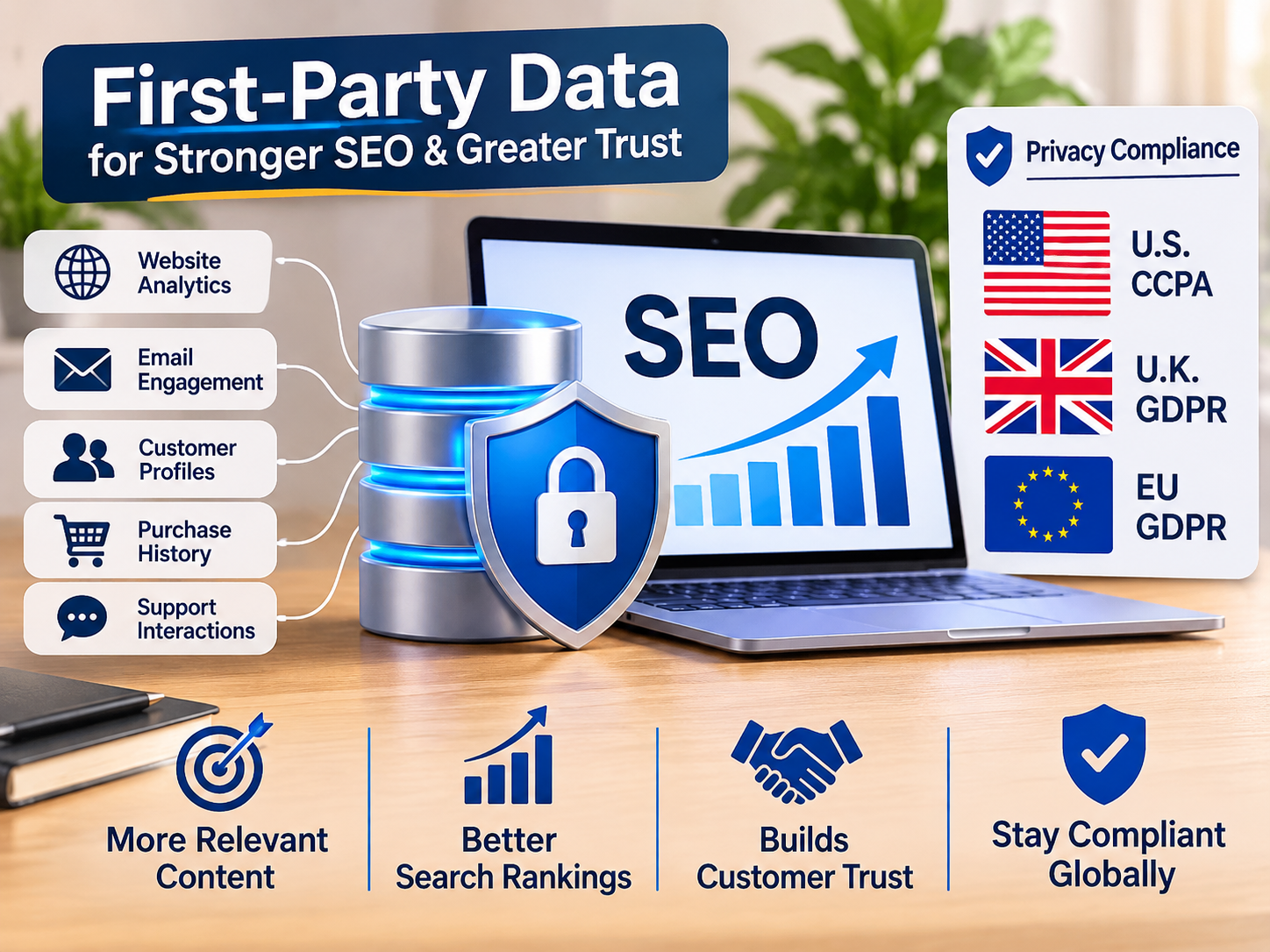
Privacy-Safe First-Party Data SEO in the US, UK, and EU
Using internal data for public research introduces privacy and confidentiality responsibilities.
A company may have permission to collect information for customer support or product analytics without automatically having permission to publish findings that could identify individual customers.
Privacy requirements differ by country, so businesses operating internationally should review their research practices before publication.
United States.
US companies should consider applicable state privacy laws, including California’s CCPA and CPRA requirements, alongside contractual and confidentiality obligations.
The California Department of Justice’s CCPA guidance provides useful regulatory background.
For example, a New York SaaS provider preparing a customer-performance benchmark should avoid exposing account identities or commercially sensitive business information.
Privacy reviews are particularly important when working with small customer segments.
United Kingdom.
UK businesses must consider the UK GDPR, Data Protection Act 2018, and relevant regulatory guidance.
The Information Commissioner’s Office explains why effective anonymization requires an assessment of whether individuals could reasonably be identified.
A report focusing on London-based companies may attract local media attention, but regional findings should be supported by an appropriate dataset.
Do not assume that removing names automatically makes information anonymous.
Germany and the EU.
Businesses in Germany and other EU countries must consider the General Data Protection Regulation, commonly called DSGVO in Germany.
Germany’s Federal Data Protection Act (BDSG) may also apply.
A Berlin-based SaaS company comparing trends across Germany, France, and the Netherlands should use consistent research definitions and evaluate cross-market data handling.
The European Commission’s data protection guidance distinguishes pseudonymization from genuine anonymization.
Pseudonymized records may still qualify as personal data.
For cross-border or sensitive research, obtain qualified legal guidance before publication.
How Original Research Earns High-Quality Editorial Backlinks
Journalists, bloggers, and industry publications frequently need credible evidence to support their reporting.
Original first-party research can give them a primary source rather than another article quoting familiar statistics.
The opportunity is strongest when your research answers a timely question and makes the evidence easy to verify.
Why Journalists Reference Original Data
Consider IBM’s Cost of a Data Breach Report 2024.
IBM reported a global average data breach cost of $4.88 million in 2024, providing a documented statistic that cybersecurity writers could reference.
You can review IBM’s published findings.
The lesson is not that every company needs a large-scale research program. It is that credible, relevant findings can become useful reference material.
Even a focused niche report may attract attention when it answers a question that has not been adequately researched.
Use Data-Driven Digital PR
Publishing research does not mean relevant publications will automatically discover it.
Identify journalists, newsletters, websites, and industry editors who regularly cover your subject.
Then prepare a concise outreach message highlighting the most useful finding.
For our hypothetical SaaS study, a possible pitch could be:
What customer support trends reveal about recurring workflow friction in SaaS products.
Link directly to the research, explain the methodology, and offer visuals that publishers can reference.
Prioritize genuine editorial coverage rather than purchased links or manipulative link schemes.
Localize Outreach for US, UK, and German Publications
Different markets may care about different aspects of the same research.
A US technology publication might focus on business productivity, while a UK industry newsletter may prefer findings relevant to British organizations.
German-language software publications may find value in comparisons supported by credible German or EU data.
Localize the actual insight, not merely the language of the pitch.
Never present global findings as country-specific statistics without supporting evidence.
How to Measure First-Party Data SEO Performance
A research campaign should be evaluated beyond the number of backlinks it attracts.
Editorial mentions, organic visibility, referral traffic, AI citations, and qualified business inquiries can all help determine whether the work is producing value.
Track Backlinks and Referral Traffic
Use tools such as Google Search Console, GA4, Ahrefs, or Semrush to monitor changes.
Prioritize relevant referring domains over raw backlink counts.
A mention from an established industry publication can be more valuable to your target audience than several unrelated links.
Monitor AI Search Visibility
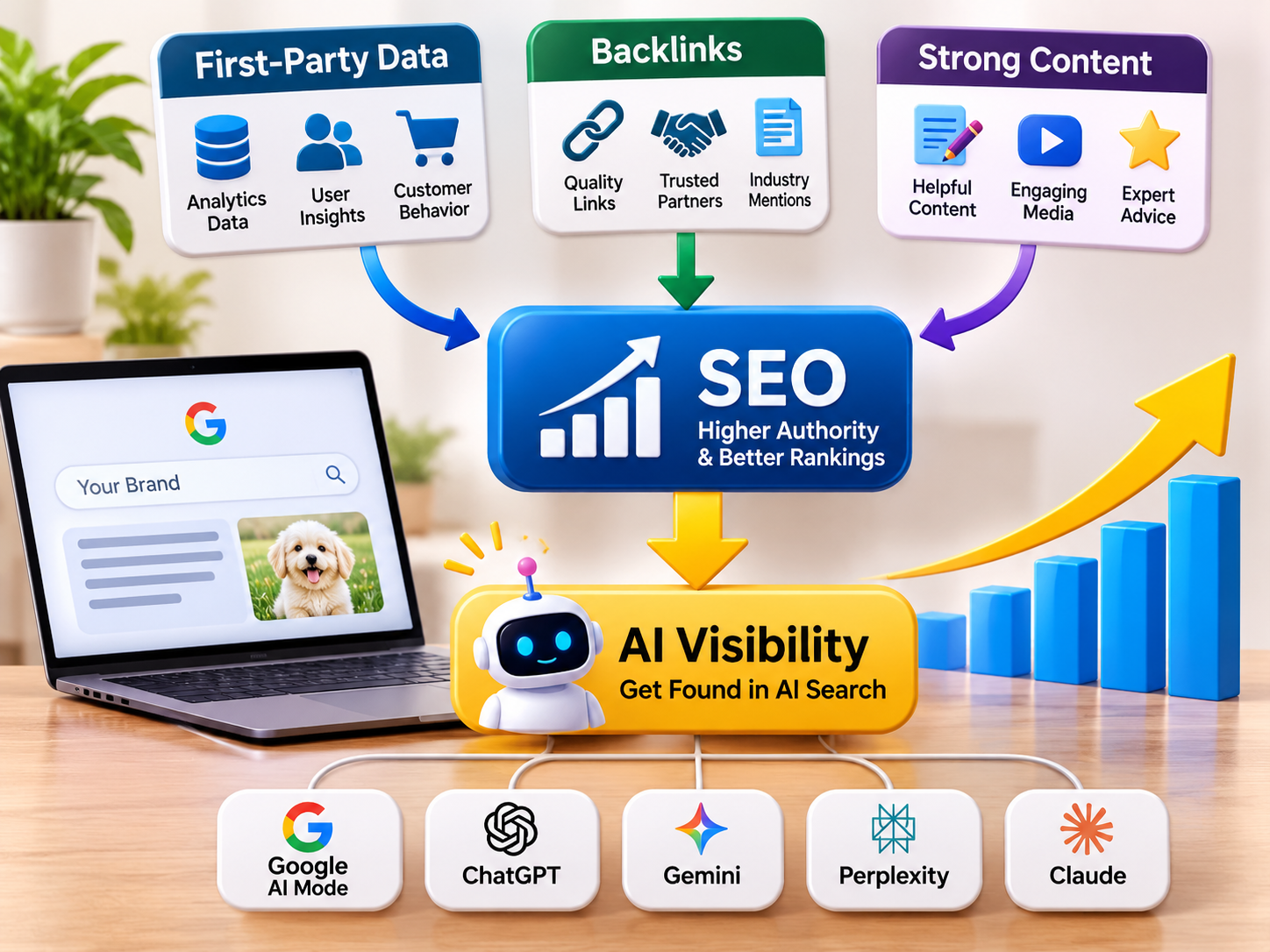
Original research can also create opportunities to be cited by AI-powered search and answer systems.
Track whether your findings appear with visible source attribution in Google AI Overviews, Chat GPT, or Gemini.
Record the query, observation date, cited URL, and context of the mention.
Because AI-generated answers can vary, repeat checks under consistent conditions rather than relying on a single observation.
For related guidance, see AI-Generated Content SEO: How to Stand Out in 2026.
Measure Research ROI
Compare campaign outcomes against the costs of research, writing, visualization, compliance, outreach, and maintenance.
| KPI | Before publication | After publication |
|---|---|---|
| Referring domains | Existing relevant links | New relevant editorial links |
| Organic traffic | Comparable baseline traffic | Research landing-page traffic |
| AI citations | Initial observed mentions | Repeated source attribution |
| Qualified leads | Existing lead volume | Research-attributable inquiries |
| Assisted pipeline | Baseline CRM values | Supported contributions to opportunities |
Use consistent reporting periods and avoid assuming every increase was caused by the research alone.
Good measurement should help you decide whether to update the report, expand the topic, or invest in another study.
Wrap It Up
Your business may already hold information that customers, journalists, and industry professionals would find valuable.
First-party data SEO helps turn that information into credible research, useful content, and opportunities for authoritative backlinks.
The process starts with identifying meaningful data, validating findings, protecting sensitive information, and publishing research that others can confidently reference.
Consistent methodology and targeted outreach matter more than producing impressive-looking reports without evidence.
For B2B companies, the goal is not simply to generate more backlinks. It is to become a reliable source of information in the markets they serve.
Mak It Solutions helps businesses develop research-led content, strengthen their SEO strategy, and connect meaningful data with digital marketing goals.
If your CRM, customer feedback, or product analytics contain untapped insights, start with a focused assessment.
Contact Mak It Solutions to discuss a first-party data content opportunity audit.
FAQs
Q : Can small B2B companies use first-party data SEO?
A : Yes. Small B2B companies can create useful research from limited datasets when the findings address a specific audience question. The key is to disclose the sample size, reporting period, and limitations rather than presenting narrow findings as universal trends.
Q : Do companies need customer consent to publish aggregated research?
A : Not always. Under GDPR and UK GDPR, consent is not the only possible lawful basis for processing personal data. However, aggregation alone does not remove privacy obligations. Businesses must assess applicable laws, confidentiality requirements, and re-identification risks before publishing.
Q : How much does a first-party data research campaign cost?
A : Costs depend on dataset quality, research complexity, editorial production, privacy reviews, visualization, and digital PR requirements. A focused report using existing clean data may cost less than a multinational benchmark. An itemized project estimate is more useful than a generic budget figure.
Q : How often should proprietary research reports be updated?
A : Update reports when meaningful new data becomes available. Annual benchmarks can work well for longer-term comparisons, while fast-changing SaaS patterns may justify quarterly updates. Maintain consistent definitions and clearly explain any methodological revisions.
Q : Can original research earn backlinks without a digital PR agency?
A : Yes. An in-house marketing team can earn relevant editorial backlinks by publishing credible research and contacting journalists who cover the topic. Specialist support can help with larger campaigns, but useful findings and targeted outreach remain essential.
The post First-Party Data SEO: The Ultimate Backlink Guide appeared first on Mak it Solutions.
Comments
Join the discussion. Comments are moderated.
No comments yet. Be the first to share a thought.
Building something related?
Tell us about your product goals — we’ll respond with a clear next step.
Discuss your project